About ClinTrialFinder
ClinTrialFinder is an independent AI tool that helps patients and caregivers identify potentially relevant clinical trials.
ClinTrialFinder was created by Qiansheng Wang, an independent developer and nasopharyngeal carcinoma patient.
Before his diagnosis, he worked as a data scientist in a startup in Singapore building machine learning systems to analyze large collections of text.
After being diagnosed, he began searching for clinical trials and discovered how difficult it was to navigate thousands of studies on ClinicalTrials.gov. Eligibility criteria are complex, and it is often unclear which trials might actually be relevant to a patient's situation.
ClinTrialFinder was built to make that process easier — helping patients and caregivers quickly identify potentially relevant trials.
Why This Exists
Beyond making trial search easier for others, this project is personal in several ways. It keeps me engaged with the frontier of oncology research. It also tackles a data science problem I care deeply about — how to surface the most relevant clinical trials for specific cancers like NPC from among thousands of possibilities. And it gives meaning to a difficult situation.
As Viktor Frankl wrote, everything can be taken from a person but the freedom to choose one's response. ClinTrialFinder is part of that response.
Presented At
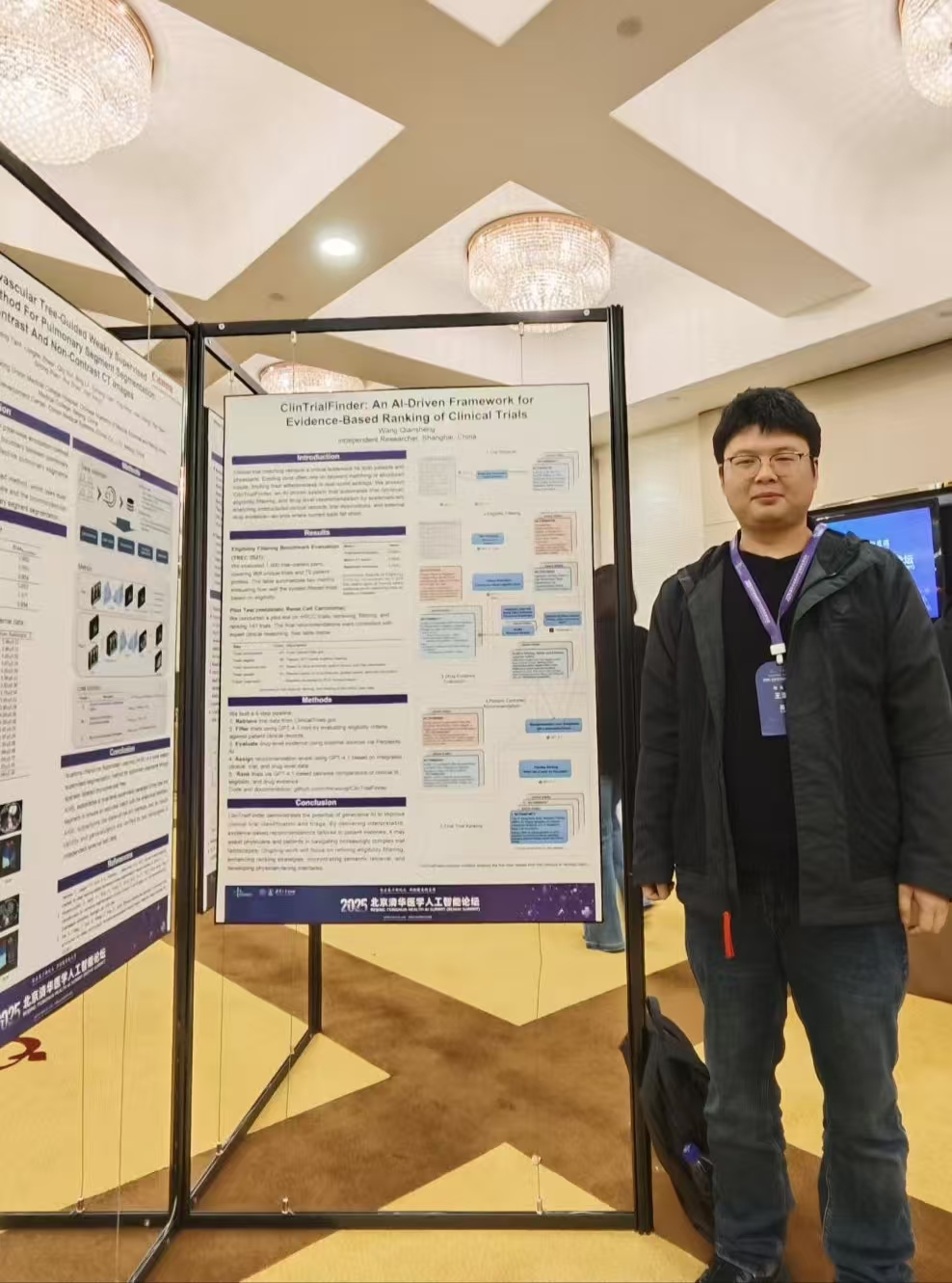
Presenting ClinTrialFinder (open-source research version) at the Beijing-Tsinghua Health AI Summit (BEIHAI Summit 2025)
How ClinTrialFinder Works
What it does — and what it doesn't. ClinTrialFinder is a starting point for your trial search, not a determination of eligibility. It helps surface trials that may be relevant to your situation so you can bring a focused list to your care team. It does not decide whether you qualify — only a trial's own study team can do that.
How the matching works, in brief. A guided questionnaire helps you describe your situation — cancer type, biomarkers, prior treatments, location — in your own words, with no medical knowledge needed to get started. ClinTrialFinder then retrieves candidate trials from ClinicalTrials.gov by disease and biomarker, including cross-cancer "basket" trials that enroll by biomarker across tumor types (which a disease-name search often misses). An AI reads each trial's eligibility criteria and compares them against your situation, criterion by criterion — not just keyword matching — an approach grounded in published research on LLM-based trial matching (TrialGPT, from NIH/NLM). Results are then ranked by a blend of how well you appear to fit, the published biomedical evidence behind each trial's drugs, and the trial's design.
Its limitations — honestly. This is preliminary, AI-generated screening, and it is imperfect. It can miss relevant trials, and it can misread complex eligibility criteria in either direction. A trial ranked lower may still be right for you; a trial it surfaces may turn out not to fit. Treat every result as a lead to verify, not an answer.
How to use your results. Every trial links to its official listing on ClinicalTrials.gov — verify the details there, and discuss any trial that interests you with your oncologist or care team before acting. ClinTrialFinder is an information tool, not medical advice.
The science it builds on. The eligibility-screening approach is grounded in published work on LLM-based patient-to-trial matching, including TrialGPT (NIH/NLM). Ranking incorporates published biomedical literature (e.g., PubMed) on the drugs and diseases studied in each trial. An open-source command-line version is also available for developers and researchers.
Privacy
No account is required to use ClinTrialFinder. We do not sell or share your data with third parties for marketing or advertising purposes. For full details, see our Privacy Policy.
Contact
Questions, feedback, or partnership inquiries: chncwang@gmail.com