What's New: Browse Before You Search
Five additions to help you understand the field, find the drug you're looking for, and get through the wizard faster.
Browse by Cancer: Trial Landscape Pages
For ten cancers — pancreatic, NPC, multiple myeloma, cholangiocarcinoma, hepatocellular carcinoma, colorectal, melanoma, non-small-cell lung, breast, and prostate — there's now a trial landscape page that surveys the active trial field at a glance: which drug classes are being tested most (ADCs, immunotherapy, cell therapy, targeted), which sponsors are most active, which trials are in Phase 3 with their acronyms, and where the trials are geographically.
This is for the question that comes before "which trials match me?" — the question of "what's actually being tried for this disease right now?" Useful for patients who want to understand the field before running a personalized search, for caregivers building a mental map, and for second-opinion conversations with a new oncologist.
The landscape pages re-aggregate from the trial corpus daily, so the counts and Phase 3 lists stay current without manual upkeep.
Examples: /trials/breast-cancer/landscape, /trials/lung-cancer-nsclc/landscape, /trials/pancreatic-cancer/landscape.
One-Click from Cancer Page to Wizard
Every disease landscape page, all 36 regular disease pages, and our major blog posts now have a "Find Trials Matching Your Profile" button that opens the wizard with your cancer already selected. You skip step 1 and start on the medical-history questions.
The intent is to shorten the path from "I read something about this disease" to "I have a personalized list of trials." Three patients across May went from a ChatGPT-cited disease page to a completed search this way (HER2+ breast cancer, cholangiocarcinoma, cervical cancer).
Browse by Drug: Eight New Drug Pages
If you've heard about a specific drug from a doctor, a paper, or a news article and want to know which trials are actively recruiting for it, there's now a drug page for each. Each page shows the drug's mechanism, all active trials grouped by indication, and the Phase 3 trial acronyms patients can search for when they want to read further.
Eight drugs got pages in May:
- tarlatamab (Imdelltra) — DLL3 × CD3 bispecific T-cell engager; FDA-approved for extensive-stage small-cell lung cancer
- ADI-PEG 20 — arginine deprivation for ASS1-deficient cancers; Phase 3 in HCC and leiomyosarcoma
- cadonilimab (AK104) — world's first approved PD-1/CTLA-4 bispecific; 10 Phase 3 trials
- ivonescimab (AK112) — world's first approved PD-1/VEGF bispecific; HARMONi-6 ASCO 2026 plenary
- trastuzumab deruxtecan (T-DXd / Enhertu) — the most-developed HER2 ADC; 18 Phase 3s including the just-approved 1L T-DXd + pertuzumab regimen from DESTINY-Breast09
- daraxonrasib (RMC-6236) — first pan-RAS(ON) inhibitor in Phase 3 (RASolute 303 in pancreatic, RASolve 301 in RAS-mutated NSCLC)
- patritumab deruxtecan (HER3-DXd / U3-1402) — first HER3 ADC to reach Phase 3 (HERTHENA-Breast03)
- rilvegostomig (AZD2936) — AstraZeneca's PD-1/TIGIT bispecific; 10 Phase 3 trials across lung, biliary, gastric, HCC, and endometrial
Browse the full set at /drugs. More to follow as Phase 3 readouts land.
A Faster Way to Tell Us Your Treatment History
The wizard's treatment-history step used to open with a long list of drug names — chemotherapies, immunotherapies, targeted therapies, hormone therapies — and ask you to tick the ones you've had. For patients who don't remember every drug, or who confuse similar-sounding names, it was the slowest and most error-prone step in the questionnaire.
The step now starts with a higher-level question: "What line of therapy are you currently on?" (treatment-naive, first-line, second-line, third-line, later-line). If that's all you remember, you can move on — the search already has enough to filter out trials that require a different line. If you do remember more, the step drills into treatment categories (immunotherapy, chemo, targeted, hormonal, etc.) with specific drugs listed inline under each category, and you expand only the categories that apply.
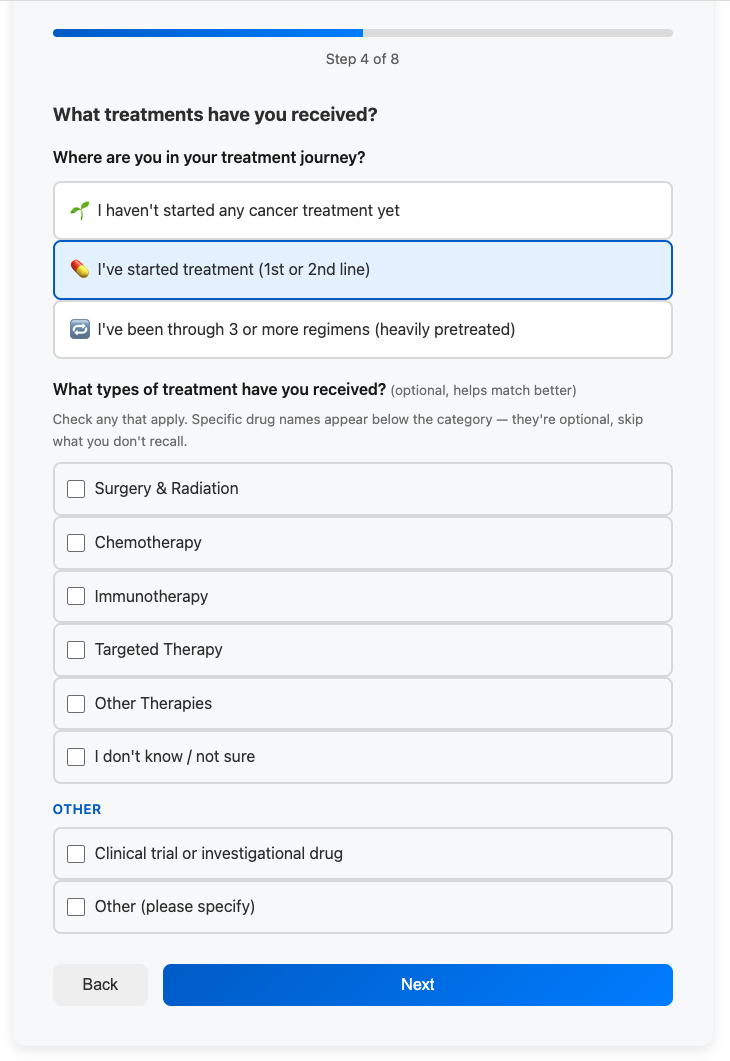
The result is a faster path for most patients and more accurate matching, because trials specify line-of-therapy eligibility much more reliably than they list every drug a patient might have received.
What's Coming at ASCO 2026
ASCO is the largest annual oncology conference, and the abstracts dropped in late May for the early-June meeting. We wrote four patient-focused previews — written for patients with the disease, not for oncologists — of what's worth watching:
Smaller Improvements
A few changes that didn't warrant a section but are worth mentioning:
- Email a link to your results from the progress page. Searches that take a while already let you sign up for a results email at the end of the wizard. You can now also drop your email mid-wait on the progress page if you decide partway through that you'd rather walk away. Three patients used this in May.
- Multilingual cancer names. The wizard now auto-detects non-Latin scripts (Chinese, Japanese, Korean, Arabic, etc.) at step 1 and translates the disease name into the matching English term before searching.
- Disease-aware question copy. Question wording adapts to the cancer type (e.g., "primary tumor" vs. "disease site" depending on whether the cancer has a primary mass).
Try It
Questions or feedback? Contact us